In rotation
Where to Buy DJ Music in 2026: WAV & Ownership
2 June 2026 · Dubrate
Where to buy DJ music in 2026: a clear-eyed guide to WAV, lossless and real ownership — Beatport, Bandcamp, Volumo, Juno and the rent-vs-own split.
In August 2023, Beatport quietly told DJs it would raise its download prices for the first time since 2005. According to Magnetic Magazine, parts of the community read it as a money grab tied to the site redesign. The same update did something quieter and more telling: it capped re-downloads of tracks you had already bought at five.
That is the real story of where to buy DJ music in 2026. The market has split cleanly into two camps — rent and own — and the gap between them is widening. This is an honest map of both, so you can decide which crate is actually yours.
Where to buy DJ music in 2026: the shortlist
Most working DJs use two or three stores, not one. Digital DJ Tips makes the same point: there is no single best store — you pick by genre and by what you value. Here is the current landscape.
- Beatport — the largest dedicated electronic-music download store and still the default. Sells MP3 or lossless WAV/AIFF/FLAC, format chosen at checkout.
- Traxsource — the house and underground specialist (deep, soulful, tech, Afro house, disco). MP3, WAV and AIFF.
- Juno Download — the long-running UK dance store. MP3, WAV and FLAC across a very broad range; each label sets its own formats and prices.
- Bandcamp — direct-to-fan, with the buyer free to pick FLAC/WAV/AIFF at no surcharge. The artist-support favourite.
- Bleep and Boomkat — London and Manchester independents for left-field electronica, both selling WAV/FLAC (Bleep even offers 24-bit hi-res WAV).
- Volumo — a newer DJ-first store that charges one price for MP3 or lossless, no surcharge.
Beatport: the incumbent is squeezing buyers
Beatport's download business is, against the wider trend, unusually healthy. At the March 2025 Beatport Connect summit, CRO Helen Sartory reported a 25% rise in download revenue and 28% growth in streaming subscribers in 2024, per Billboard. It is not going anywhere.
But the terms have shifted against the buyer. On the download side, lossless costs roughly £0.70 more per track than the MP3, and you can retroactively upgrade an MP3 to lossless for that same difference, per Beatport's own support pages. Individual tracks broadly sit in the $1.29–$2.99 band. That MP3-versus-WAV upsell is a deliberate choice, and not every store makes it.
The bigger shift is the push toward renting. Beatport Streaming runs four tiers — Essential $10.99, Advanced $15.99, Professional $29.99, Professional+ $34.99 a month, per stream.beatport.com. And streaming is exactly that: a rental. Beatport's support docs confirm that if you cancel, the tracks in your Collection and offline locker become unavailable until you re-subscribe. Stop paying, lose the set.
A few details serious DJs should know before subscribing:
- Streaming audio is 128/256kbps AAC, not lossless. Lossless FLAC streaming only arrived in October 2024, per DJ TechTools, and only on the Professional and Professional+ tiers.
- The offline locker is capped — around 1,000 tracks on Professional — and those offline files are 256kbps AAC, not lossless.
- Purchased downloads are limited to five re-downloads (no time limit); only active streaming subscribers keep unlimited re-downloads, per Beatport support.
None of this makes Beatport a bad store. Its catalogue is the deepest in dance music. But the direction of travel is clear, and it points away from you owning the file. We unpack the alternatives in our Beatport guide for DJs.
The house and underground stores: Traxsource and Juno
If you mix house in any of its forms, Traxsource is the specialist — deep, soulful, tech and Afro house, plus disco. It sells MP3, WAV and AIFF, with pricing that tracks Beatport's and frequent discounts, per Digital DJ Tips.
Juno Download is the long-running UK option, selling MP3, WAV and FLAC across an enormous genre spread. The catch is uniformity: each label or distributor sets its own formats and prices, so deals vary track to track. If Juno is your home base, it is worth knowing where else to look when a release is missing or overpriced.
Bandcamp: best-in-class ownership, with an asterisk
For owning files and supporting artists, Bandcamp is hard to beat. A single purchase can be downloaded as lossless WAV, FLAC, AIFF or ALAC at no extra charge — no upsell, per Bandcamp's help centre. Artists keep an average of around 82%, and the platform has paid out roughly $1.64 billion to date. Bandcamp Fridays — where it waives its cut — have generated about $154m since 2020, with eight more scheduled in 2026.
The asterisk is stability, not generosity. Bandcamp was bought by Epic Games in 2022, then sold to licensing firm Songtradr in October 2023, after which Variety reported roughly half the staff were laid off, including the entire union bargaining team. In January 2026 it banned AI-generated music. It remains the ethical default for crate-diggers — see our take on Bandcamp for DJs — but the ownership churn is why some DJs keep a personal backup rather than trusting any platform forever.
Volumo and the "lossless at one price" model
Here is the quiet shift worth noticing. Volumo, launched in 2022 and AFEM-approved, charges the same price whether you pick MP3 or lossless WAV/AIFF/FLAC — no surcharge — at around €1.49 a track, and pays artists a 75% split, per Crossfader's review. Together with Bandcamp, it proves a fairer, ownership-first store is viable, not just idealistic.
That is the model Dubrate is built on. Every purchase is a real, downloadable lossless WAV/FLAC file that is yours forever — no subscription required, no DRM, no MP3-versus-WAV upsell. It plays on rekordbox, Serato, Engine DJ and the CDJ-3000 the same as any other file. Artists keep 85% (a 15% platform fee), with weekly Stripe payouts, and every track is tagged with BPM and Camelot key for harmonic mixing. Browse the catalogue or filter by genre to see how it works.
Do DJs actually need WAV? The honest answer
This is where myth meets evidence. In controlled blind tests, most listeners — even trained ears on good gear — cannot reliably tell 320kbps MP3 from WAV, including on a club rig, per B&H Explora. So the case for lossless is not magic ears.
The real reasons are practical: avoiding generation loss when you re-edit or re-export a track, and future-proofing your crate against whatever format comes next. Your software is ready for it — Serato DJ Pro supports FLAC, AIFF, WAV and ALAC; rekordbox and the CDJ-3000 handle WAV, AIFF, FLAC and ALAC, processing everything internally at 96kHz/32-bit float; and Engine DJ runs FLAC and WAV on standalone players. If lossless is offered at no extra cost, there is no reason not to take it.
Rent or own? The market has already voted
Step back and the trend is stark. According to the RIAA's 2025 report, US permanent downloads fell about 6% to roughly $221.8m — under 2% of an $11.5bn market. Buying to own is now a deliberate, minority behaviour. That is the DJ and collector niche, precisely.
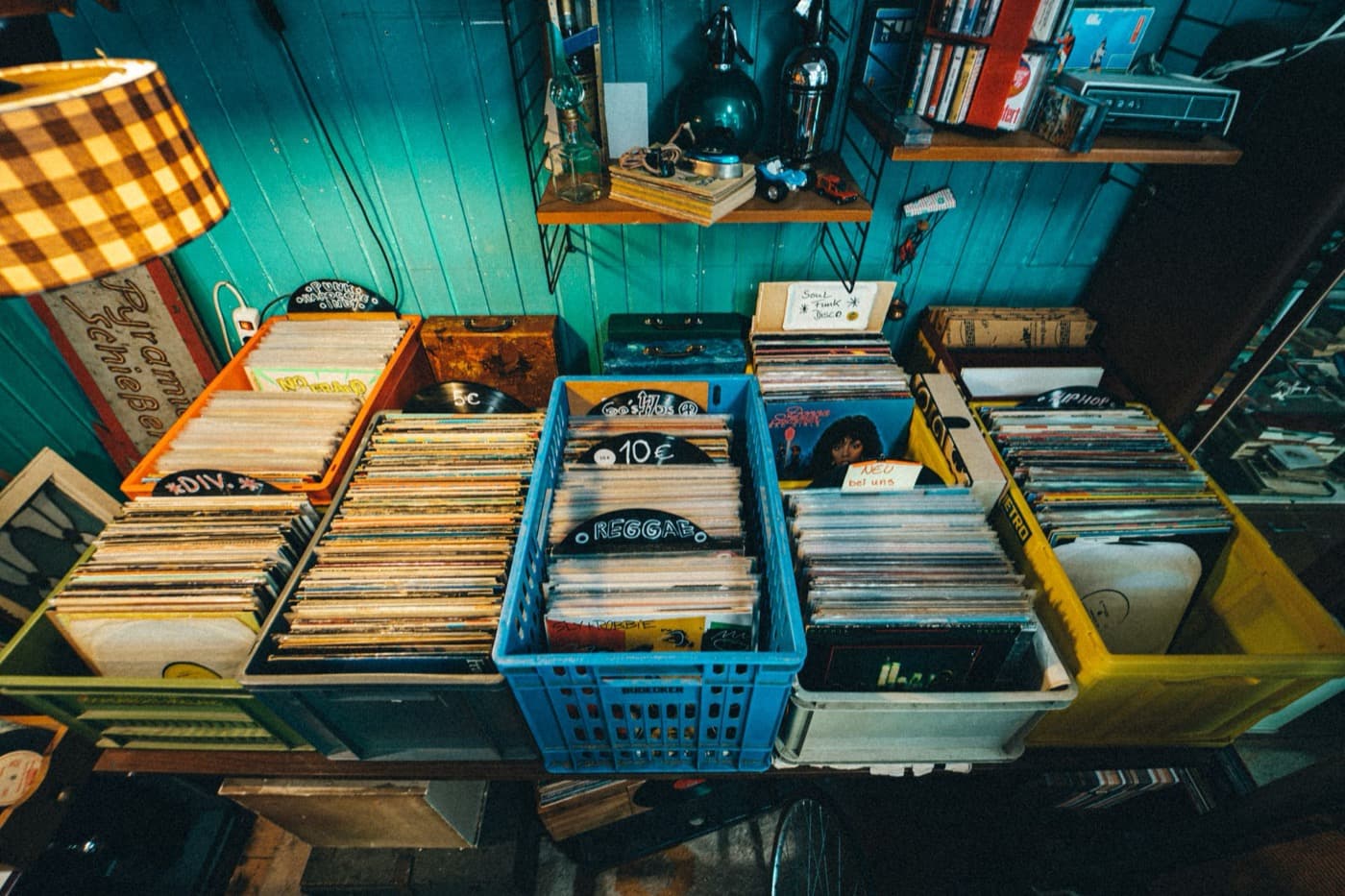
And yet vinyl crossed $1 billion in 2025, up 9.3% — its 19th straight year of growth, with independent stores selling more than four in ten records. People still pay a premium for permanence. Digital DJ Tips puts the principle plainly: owned local files are "truly yours forever — no streaming service going bankrupt... can affect the availability of tunes you actually own." We go deeper on that in streaming vs owning your DJ tracks.
The takeaway is not that one store wins. Use Beatport for breadth, Traxsource for house, Juno or Bleep for reach. But own the tracks that matter — the set-makers, the exclusives, the ones you would be lost without — as lossless files you keep regardless of who gets bought, who raises prices, or who caps your re-downloads next.
That is what Dubrate is for. Buy direct. Pay fair. Own the file. Start your crate at app.dubrate.co.uk.